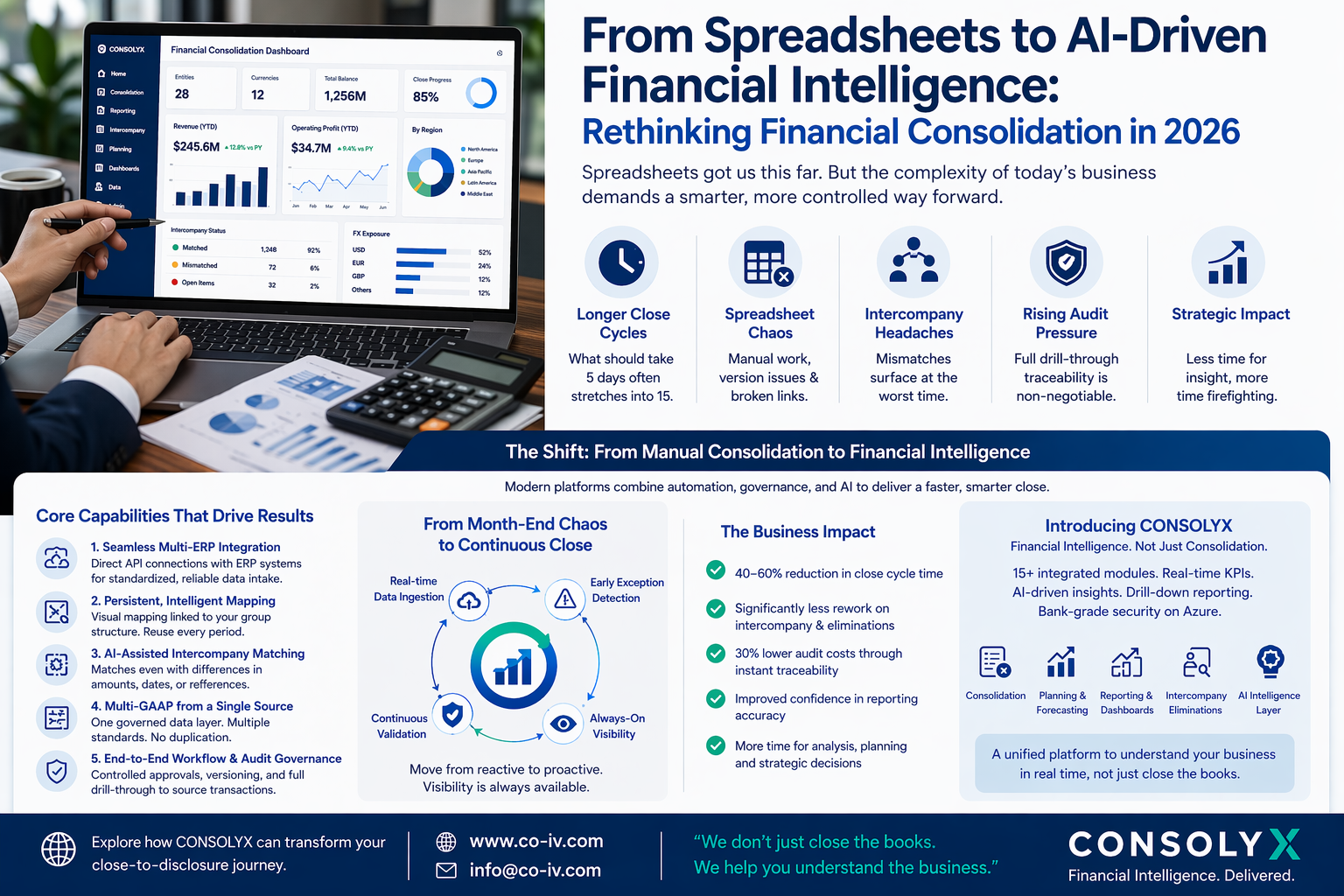
From Spreadsheets to Financial Intelligence, Why CFOs Are Rethinking Consolidation in 2026.
Financial consolidation is no longer just about closing the books — it’s about gaining real-time control over complex, multi-entity operations. As businesses scale across systems, currencies, and reporting frameworks, spreadsheet-based processes are becoming increasingly fragile and inefficient. Leading finance teams are now adopting AI-powered platforms to automate workflows, improve accuracy, and ensure full traceability.
The Close Is Broken — But Most Teams Accept It
Every CFO, Controller, or Finance Head has a version of this story.
You go into month-end expecting a 5-day close.
It quietly turns into 10… sometimes 15.
Not because your team lacks skill —
but because the process itself is fragile.
- Trial balances arrive in different formats
- Intercompany mismatches show up late
- Files keep changing versions
- And your team spends more time fixing Excel than analyzing business performance
For growing and mid-sized groups, this has become normal.
But it shouldn’t be.
Spreadsheets Didn’t Fail — They Outlived Their Design
Let’s be clear: Excel is not the problem.
It was never designed to handle:
- 20–30+ entities across countries
- Multiple ERPs (SAP, Oracle, Dynamics, local systems)
- IFRS, US GAAP, and local reporting together
- Constant structural changes from acquisitions
- Audit demands for full traceability
At smaller scale, spreadsheets worked perfectly.
At today’s scale, they introduce risk, delay, and dependency on individuals.
What CFOs Don’t Always Say — But Experience Daily
Behind every stretched close is the same hidden workload:
- Teams spending days just aligning formats
- Mapping files breaking every time something changes
- Intercompany differences discovered too late
- Audit requests turning into manual investigation exercises
- Multiple versions of “final numbers” floating around
This isn’t just inefficiency.
It creates:
👉 Pressure on teams
👉 Delayed decision-making
👉 Increased audit exposure
👉 Reduced confidence in numbers
A Quick Reality Check
If you’re leading finance today, ask yourself honestly:
- Can you trace any consolidated number to its source within 1 minute?
- How much time is spent on manual work vs real analysis?
- Are issues identified early… or do they explode at the end?
If these sound familiar — you’re not behind.
You’re in the majority.
But the leading finance teams are now moving away from this model.
The Real Shift Isn’t Automation — It’s Control + Intelligence
Many companies think they need “automation.”
In reality, they need something deeper:
👉 A controlled, governed system for financial data
👉 With intelligence built into the process
This is where modern financial platforms come in.
What Modern Consolidation Actually Changes
Instead of managing files…
Finance teams start managing a structured system.
1. Data Comes In — Automatically
No more chasing files.
- Direct connection with ERPs
- Standardized data ingestion
- Same process every month
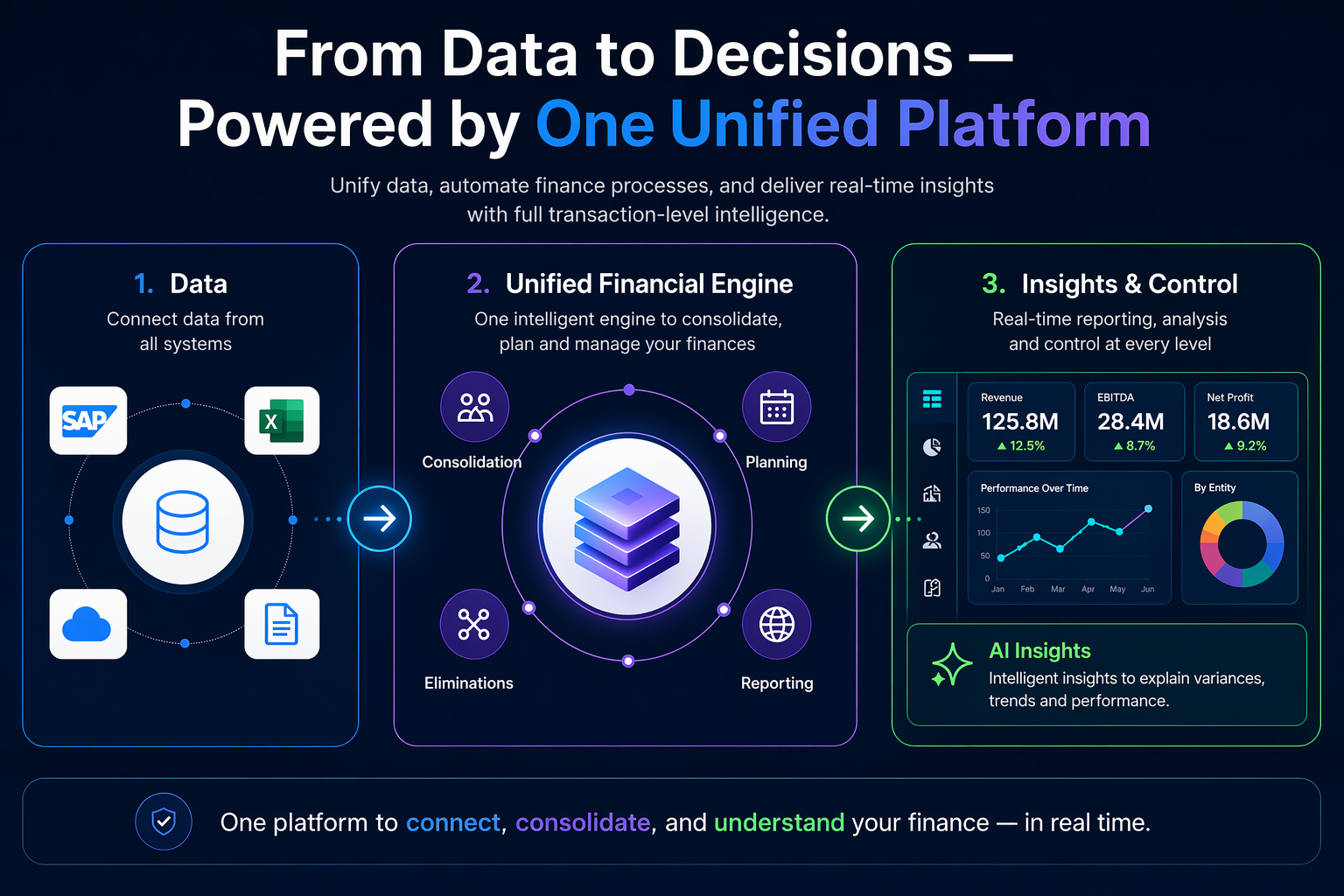
2. Mapping Becomes Stable (Not Fragile)
Instead of multiple Excel mapping sheets:
- One centralized, visual mapping logic
- Reusable every period
- Easy to maintain when structure changes
3. Intercompany Matching Becomes Intelligent
Instead of manual matching:
- System identifies likely matches
- Handles small differences in amount/date
- Highlights only real exceptions
4. Multi-GAAP / IFRS Stops Being a Burden
Instead of duplicating effort:
- One dataset
- Multiple reporting views (IFRS, US GAAP, local)
- No rebuild required
5. Audit Stops Being a Fire Drill
Instead of searching folders:
- Drill-down from report → transaction
- Full traceability
- Controlled approvals and logs
From Month-End Pressure to Continuous Visibility
Traditional close is reactive.
Modern finance functions operate differently:
- Data flows in continuously
- Issues are identified earlier
- Visibility is always available
This reduces the “month-end shock.
What Finance Teams Actually Gain
This is what changes in practice:
- Close cycles reduced by 70%
- Time spent on reconciliations drops significantly
- Audit discussions become smoother
- Finance teams spend more time on insight — not cleanup
And most importantly:
👉 Leadership trusts the numbers faster
Where CONSOLYX Fits Into This Shift
As finance moves forward, the expectation is no longer:
“Can we close the books?”
The expectation is:
👉 “Can we understand the business in real time?”
That’s where platforms like CONSOLYX come in.
From the actual environment:
- Integrated modules across the full finance cycle
- Real-time dashboards and KPI visibility
- AI-driven insights and forecasting
- Drill-down to transaction level
- Secure, Azure-based infrastructure
It’s not just consolidation.
It’s a financial intelligence layer on top of your data.
A Practical Way to Think About It
Traditional approach: 👉 Collect → Fix → Reconcile → Report
Modern approach: 👉 Connect → Validate → Understand → Decide
That shift is where the real value sits.
The Bottom Line
Spreadsheets are not going away.
But they are no longer strong enough to act as the foundation of financial control.
The complexity of modern business has simply outgrown them.
✅ Final Thought
The question is no longer:
“Can we still manage with spreadsheets?”
The question is:
👉 “Are we comfortable running finance on a fragile system?”
✅ Call to Action
If you're leading finance today — what is your biggest challenge?
- Intercompany reconciliation?
- Multi-GAAP / IFRS reporting?
- Audit & traceability?
- Data ingestion & mapping?
Explore how modern platforms are changing this space: