Why ESG Data Is Becoming Financial Data — And Why Modern Finance Teams Must Prepare Now
ESG is no longer a side conversation led only by sustainability teams. It is fast becoming part of core financial decision-making. This article explores why ESG data is evolving into financial data, how AI and finance intelligence are changing the reporting landscape, and what finance leaders must do now to build visibility, trust, and long-term business resilience.
In many organizations, ESG still sits in a separate corner.
It is often managed in spreadsheets, handled by different teams, and discussed as a reporting requirement rather than a business capability. Finance focuses on revenue, margins, cash flow, and performance. Sustainability teams focus on carbon, energy, governance, and social impact. Both are important, but in too many companies, they still operate in parallel rather than together.
That separation is becoming harder to defend.
The reality is simple: ESG data is no longer just a compliance topic. It is rapidly becoming decision-making data. It influences investor confidence, cost structures, operational resilience, procurement choices, funding access, and long-term enterprise value. In practical terms, that means ESG data is starting to behave like financial data. And once that happens, finance teams can no longer afford to treat it as someone else’s responsibility.
This is where a major shift is now taking place.
For years, finance leaders worked in a world where the main challenge was closing the books faster, preparing management reports, improving control, and building trust in the numbers. That work is still critical, but expectations are changing. Today, leaders are being asked not only what happened financially, but also what is happening operationally, environmentally, and strategically across the business. They are expected to connect financial outcomes with real-world drivers such as energy use, supply chain disruption, emissions exposure, resource efficiency, and governance risk.
That is a different level of visibility.
And it changes the role of finance entirely.
Modern finance is no longer just about reporting the past. It is increasingly about creating a connected layer of intelligence for business decisions. In that environment, ESG data becomes deeply relevant. If a company’s carbon exposure affects future operating costs, that is a finance issue. If resource inefficiency reduces margins, that is a finance issue. If governance failures damage investor confidence, that is a finance issue. If sustainability commitments influence capital allocation, pricing, procurement, and expansion strategy, those are all finance issues too.
This is why the conversation matters now.
Many organizations still treat ESG reporting as a presentation exercise. A report is prepared, some indicators are gathered, and a polished narrative is shared with stakeholders. But internally, the business may still lack integrated visibility. The numbers may not be linked to operational systems. The metrics may not be aligned with financial reporting cycles. And leadership teams may not have the drill-down needed to understand what is improving, what is deteriorating, and where action is required.
That is the real gap.
The challenge is not whether ESG reports exist. The challenge is whether ESG information is usable, trusted, timely, and connected to business performance.
This is where finance teams have a major opportunity.
Finance already understands discipline, controls, structure, reconciliation, materiality, and reporting logic. These strengths are highly relevant to ESG and sustainability data. In fact, one of the biggest opportunities for finance leaders over the next few years is to help move ESG from fragmented reporting into managed intelligence. That means building processes that make ESG data more consistent, more visible, and more decision-useful.
But this shift will not happen through manual effort alone.
The volume and complexity of data are increasing too quickly. Carbon metrics, energy consumption, operational indicators, supplier data, internal controls, governance information, and business performance signals are all moving at the same time. If these remain scattered across spreadsheets and disconnected systems, the result is predictable: slow decisions, low confidence, weak accountability, and reporting fatigue.
This is one reason AI is becoming so important in modern finance and sustainability environments.
AI is not valuable simply because it is fashionable. It is valuable because it can help businesses make sense of complex, fragmented, high-volume data. In the context of finance and ESG, AI can support data structuring, anomaly detection, mapping, pattern recognition, forecasting, and insight generation. It can help teams identify gaps, highlight inconsistencies, and reduce the burden of manual review. Most importantly, it can help move organizations from static reporting toward more connected intelligence.
That matters because the future will not reward businesses that only produce more reports. It will reward businesses that create better visibility.
A finance team with strong visibility can answer deeper questions. Why are margins changing in one business unit while energy intensity is increasing in another? Why is one supplier relationship creating governance risk? Why is one region showing stronger operational resilience despite higher short-term cost? Why are sustainability targets not reflecting actual business behavior? These are not isolated sustainability questions. They are strategic finance questions.
And this is exactly why the relationship between finance intelligence and ESG intelligence will become stronger, not weaker.
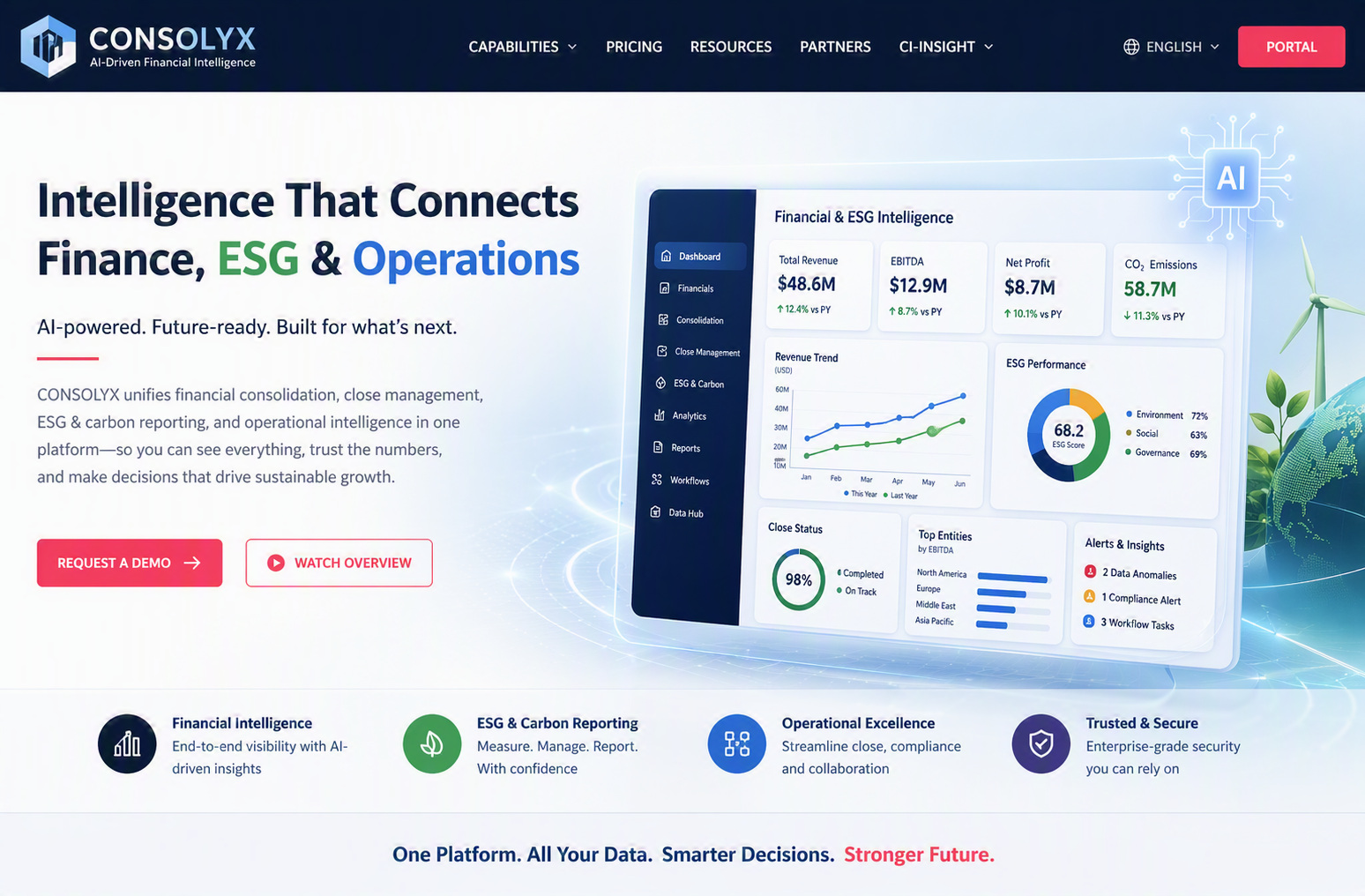
Forward-looking companies are already moving in this direction. They are beginning to connect financial reporting, operational reporting, ESG metrics, and management dashboards into more unified environments. They want a clearer view of performance across the enterprise. They want fewer disconnected systems. They want greater traceability from headline metrics down to the source. And they want leadership teams to spend less time collecting information and more time using it.
This is the bigger shift behind digital transformation in finance.
For many years, transformation was discussed in terms of automation. Can reports be faster? Can processes be digitized? Can workflows be improved? Those questions still matter, but leading organizations are now asking something more important: can the business see clearly enough to act early?
That is a more mature question.
It reflects the movement from automation to intelligence.
And in that world, ESG data becomes much more than a reporting line item. It becomes part of how the organization understands resilience, efficiency, risk, opportunity, and long-term value creation.
Of course, there are still real barriers. Data quality remains inconsistent. Definitions vary between teams. Ownership is often unclear. Some companies still lack a practical structure for integrating ESG and finance processes. Others have technology in place but no unified data model. And in many cases, leadership teams want insights, but the underlying reporting model is still too manual to support them consistently.
These are common problems, but they are solvable.
The first step is mindset. Businesses need to stop viewing ESG as separate from enterprise performance. The second step is structure. The data must be captured in a way that supports review, traceability, and comparison. The third step is integration. Financial, operational, and sustainability information must begin to speak to each other. The fourth step is intelligence. Teams need tools that help them move from collection to interpretation, and from interpretation to action.
This is where finance leaders can play a defining role.
The finance function has always been trusted to bring order to complexity. That same strength is now needed in a broader context. Not just to produce financial statements, but to build confidence in the wider information that shapes strategy. Not just to explain past performance, but to support future decisions. Not just to report what the business earned, but to help explain how the business is creating resilient value in a world that is changing quickly.
That is why this shift matters so much.
ESG data is not replacing financial data. It is joining it.
And the organizations that understand this early will be better positioned than those that continue to treat sustainability and finance as separate conversations. They will have better visibility, stronger trust in their information, sharper decision-making, and greater readiness for what investors, regulators, customers, and leadership teams increasingly expect.
The future of finance will not be built on financial data alone.
It will be built on connected intelligence.
And in that future, ESG data will not sit at the edge of the business. It will sit much closer to the center.