If We Already Have ERP Systems, Why Do We Need a Financial Intelligence Platform?
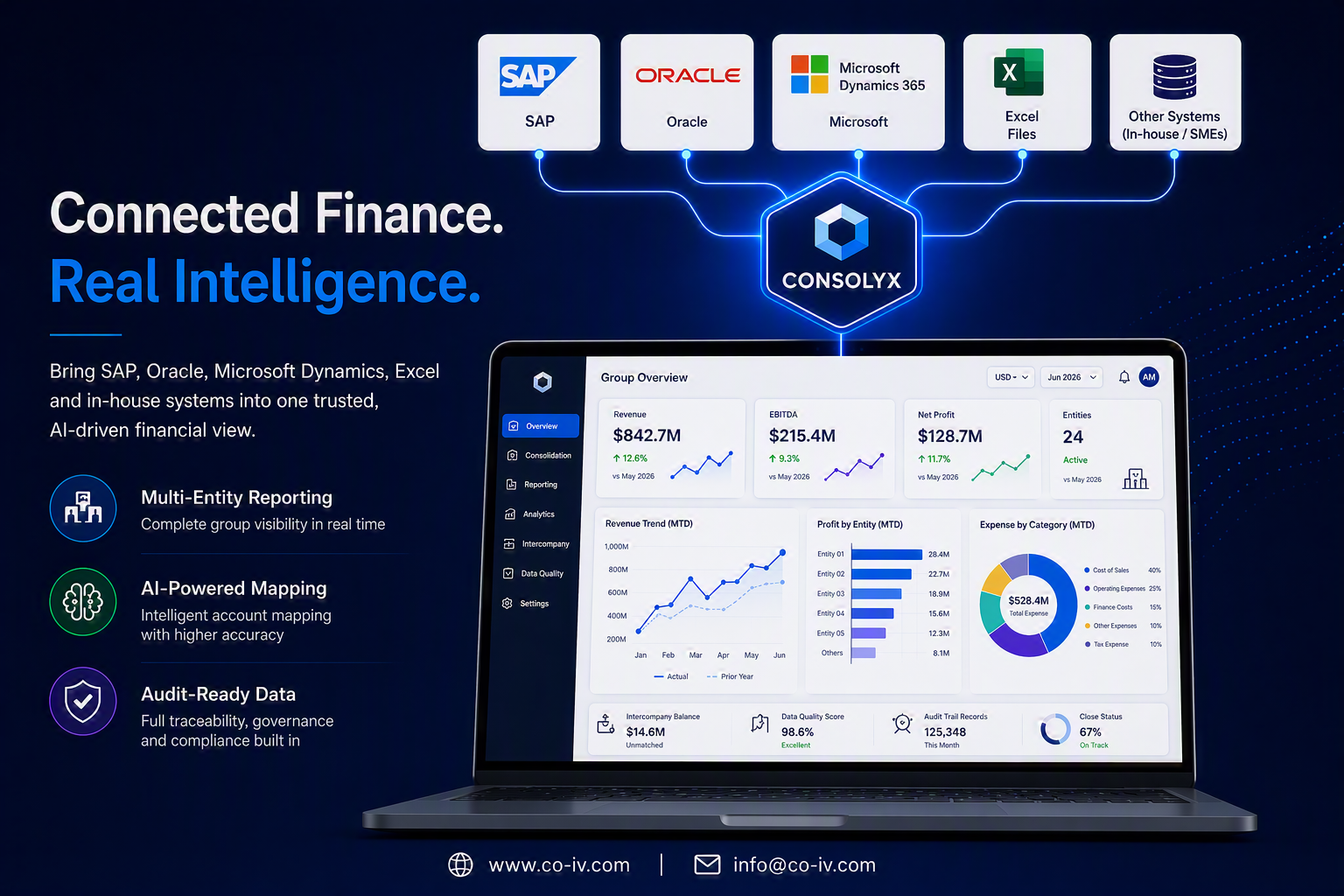
Many organizations already use SAP, Oracle, and Microsoft Dynamics — so why build another platform? This article explains why financial intelligence platforms are not replacements, but essential layers that bring control, visibility, AI-driven mapping, and audit-ready reporting across multi-entity environments.
This is one of the most common — and most valid — questions raised by executive management.
“We already have SAP.”
“We are using Oracle.”
“We have Microsoft Dynamics in place.”
“Why are we building or investing in another platform?”
At first glance, it sounds like duplication.
But in reality, it highlights a misunderstanding of what modern finance actually needs.
Because the real issue is not systems.
The real issue is how disconnected those systems become when leadership needs a complete, trusted, group-level view of the business.
ERP Systems Are Excellent — But They Solve a Different Problem
There is no doubt that ERP systems are powerful.
SAP, Oracle, Microsoft Dynamics, and similar platforms are designed to:
- Capture transactions
- Manage operations
- Maintain accounting records
- Support compliance at entity level
They are the backbone of finance operations.
But they are not designed to answer complex group-level questions across multiple companies, systems, and structures.
For example:
- Can you instantly see group-wide performance across 10 entities using different ERPs?
- Can you map all local charts of accounts into one unified group structure automatically?
- Can you track how a number moved from a branch-level entry to a consolidated report?
- Can you ensure consistent governance across systems?
In most cases, the answer is not completely.
Because ERP systems are built for processing, not group-level intelligence.
The Reality: Finance Data Is Distributed
In growing organizations, financial data is spread across:
- Multiple ERP systems (SAP, Oracle, Dynamics)
- Different countries and entities
- Separate charts of accounts
- Various currencies and reporting timelines
- Excel-based adjustments and uploads
This creates a situation where:
👉 Data exists
👉 Systems exist
👉 Reports exist
But clarity does not exist
And that is where leadership starts to feel uncomfortable.
So Why Build Another Platform?
Let’s answer this directly — in the same way you would explain to executive management.
1. It Is Not Another ERP — It Is a Connecting Layer
A financial intelligence platform is not replacing SAP or Oracle.
It is connecting them.
Think of it like this:
- ERP = transaction engine
- Financial Intelligence Platform = decision engine
You are not duplicating work.
You are structuring it in a way that the business can actually use it.
2. It Reduces Human Dependency — It Does Not Increase It
This is a critical misunderstanding.
Many executives assume:
👉 “Another platform means more work, more people, more cost.”
But in reality, the opposite happens.
Today, without a proper intelligence layer:
- Finance teams manually collect data
- Mapping is done in Excel
- Adjustments are tracked offline
- Consolidation involves multiple iterations
- Errors are corrected late
This means heavy human dependency.
A good financial intelligence platform:
- Automates data collection
- Applies mapping consistently
- Flags issues early
- Reduces rework
- Standardizes reporting
So instead of increasing effort, it removes repetitive effort and allows finance teams to focus on analysis.
3. It Solves the Problem ERP Systems Cannot Solve Easily
ERP systems are strong individually.
But they struggle when:
- Multiple systems must work together
- Data structures are different
- Group-level consolidation is required
- Audit trail across systems is needed
A financial intelligence platform is designed exactly for this layer.
It brings:
- Standardization
- Alignment
- Consistency
Without touching the core ERP systems.
4. It Improves Data Trust — Which Leaders Care About Most
Executives are not worried about the number of reports.
They are worried about:
👉 “Can we trust the numbers?”
This is where most organizations struggle.
Because:
- Data is manually adjusted
- Mapping is not always consistent
- Audit trail is incomplete
- Changes are not fully visible
A financial intelligence platform introduces:
- Controlled workflows
- Data validation
- Audit logs
- Traceability
So every number becomes explainable — from source to report.
5. It Enables AI — In a Controlled Way
AI is becoming a key part of finance.
But AI cannot work properly on messy, disconnected data.
A financial intelligence platform creates a structured and governed data foundation where AI can:
- Suggest account mappings
- Detect anomalies
- Highlight unusual trends
- Support forecasting
Importantly:
👉 AI suggests
👉 Finance approves
This keeps control in the hands of professionals.
6. It Prepares Organizations for Growth
As organizations expand, complexity increases:
- More entities
- More systems
- More reporting requirements
- More regulatory pressure
If there is no central intelligence layer:
👉 Complexity grows faster than control
A financial intelligence platform ensures that growth remains manageable.
7. It Strengthens Audit and Compliance
From an audit perspective, this is critical.
Auditors often struggle when:
- Data is coming from multiple systems
- Adjustments are done manually
- Documentation is missing
- Reconciliation is unclear
A centralized intelligence layer provides:
- Full audit trail
- Data lineage
- Controlled adjustments
- Clear visibility
This reduces audit risk significantly.
So the Real Answer to Management Is This:
We are not building another system.
We are fixing the gap between systems.
Because that gap is where:
- Errors occur
- Time is lost
- Trust is reduced
- Decisions are delayed
The Real Value: Group-Level Financial Intelligence
Once this layer is in place, the benefits become clear very quickly.
Leadership can finally see:
- Which entity is performing well
- Where margins are dropping
- What is driving group-level changes
- Which intercompany balances are unresolved
- How currency movement is impacting results
Not in weeks.
But almost in real time.
Why This Matters Now
Finance expectations are changing rapidly.
CFOs are now expected to deliver:
- Faster reporting
- Real-time insights
- ESG integration
- Investor-ready data
- Strong governance
Trying to deliver all this using disconnected systems and spreadsheets is not sustainable.
Final Thought
ERP systems are not the problem.
They are essential.
But they were never designed to provide complete, connected, group-level intelligence across multiple systems.
That is why financial intelligence platforms are not optional anymore.
They are the missing layer.
This is exactly the direction CONSOLYX is being built — to connect existing systems, reduce manual effort, apply AI intelligently, and deliver trusted, audit-ready financial insights at the group level.