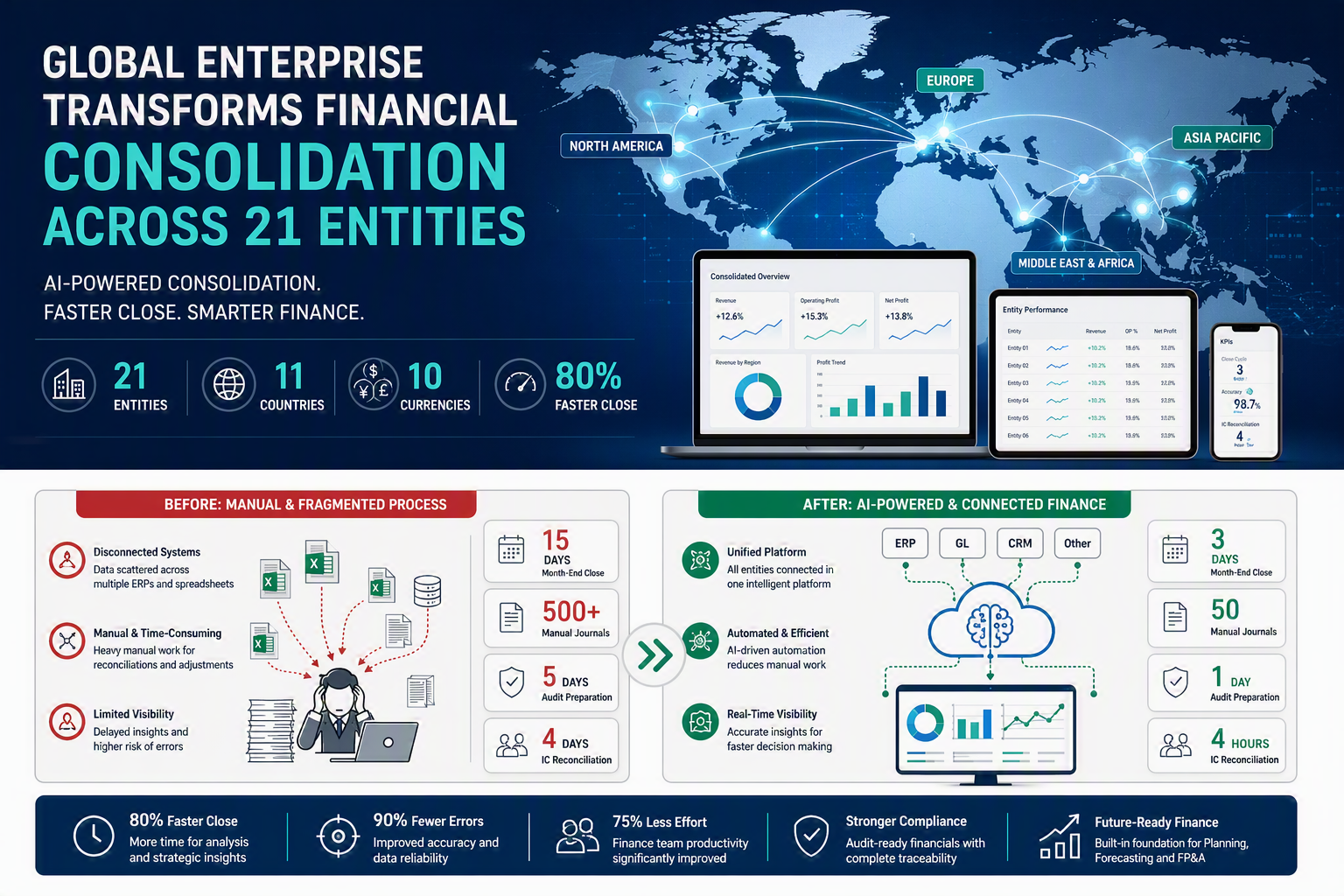
Global Enterprise Transforms Financial Consolidation and Reporting Across 21 Entities
As organizations expand across geographies, currencies, and legal structures, finance teams often find themselves spending more time gathering data than generating insights. How an AI-Powered Consolidation Framework Reduced Month-End Close by 80% and Established the Foundation for Modern FP&A
Industry
Diversified Multinational Group
Operations
Asia Pacific, Europe, Middle East, Africa, and North America
Scope
- 21 Legal Entities
- 11 Countries
- 10 Reporting Currencies
- 3 Continents
- 20+ Intercompany Relationships
- 1,000+ Account Mappings
Executive Summary
As organizations grow across regions, currencies, and business units, finance teams often face increasing pressure to deliver fast, accurate, and compliant financial information.
For this multinational group, financial consolidation had become increasingly complex. Multiple accounting frameworks, currencies, subsidiaries, business units, and intercompany transactions were creating significant reporting challenges and extending the month-end close process.
The organization needed a better way to consolidate financial information, improve reporting transparency, strengthen governance, and establish a scalable foundation for future Financial Planning & Analysis (FP&A), budgeting, and forecasting initiatives.
What followed was a finance transformation journey that fundamentally changed how the organization manages reporting, consolidation, and business decision-making.
About the Organization
Headquartered in Southeast Asia, the Group operates across Asia Pacific, Europe, the Middle East, Africa, and North America, with business interests spanning manufacturing, services, trading, technology, and investment operations.
The organization's financial landscape reflected the complexity of a truly global enterprise:
- 21 legal entities
- Operations across 11 countries
- Financial reporting in 10 currencies
- Presence across 3 continents
- More than 1,000 account mappings
- Over 20 intercompany relationships requiring matching, reconciliation, and elimination
While business expansion created new opportunities, it also introduced significant pressure on the finance function to maintain consistency, control, and reporting accuracy.
The Challenge
The finance team was dealing with a reality familiar to many multinational organizations.
Month after month, financial information arrived from multiple entities, each operating with different charts of accounts, local reporting structures, accounting standards, and business processes. Before consolidated reporting could begin, finance teams were required to collect, validate, map, reconcile, translate, adjust, and eliminate significant volumes of financial data.
The complexity extended beyond data volume.
Entities reported under various accounting standards, including IFRS-based frameworks, US GAAP, UK GAAP, Dutch GAAP, and several local reporting standards. Financial information also required consolidation across ten currencies while ensuring consistency and compliance at Group level.
Intercompany transactions added another layer of difficulty.
Management fees, loans, trade balances, dividends, and shared service allocations required continuous matching and elimination. Even minor differences could lead to lengthy investigations and reconciliation efforts across multiple finance teams.
As a result, the monthly close process extended to approximately fifteen days, delaying management reporting and limiting access to timely business insights.
The Turning Point
Finance leadership recognized that growth could no longer be supported through additional spreadsheets, manual reconciliations, and disconnected reporting processes.
The organization required a scalable financial consolidation platform capable of supporting international operations while improving reporting quality, governance, and operational efficiency.
The vision was straightforward:
Create a unified financial reporting framework that could connect entities, currencies, ownership structures, charts of accounts, and reporting requirements within a single environment.
However, the objective extended beyond accelerating month-end close.
The organization wanted to transform finance from a reporting function into a strategic business partner capable of delivering insights, supporting decisions, and enabling future growth.
The Solution
The organization implemented a comprehensive AI-powered financial consolidation and reporting framework designed specifically for complex multinational groups.
The solution established a centralized financial intelligence model covering:
- Organizational hierarchy management
- Ownership and control structures
- Multi-currency translation
- Consolidation rules and methodologies
- Group chart of accounts
- Local chart of accounts
- Account mapping management
- Intercompany reconciliation and eliminations
- Exchange rate management
- Trial balance collection
- Consolidated financial reporting
- Audit trail and traceability capabilities
Rather than treating consolidation as a month-end activity, the platform created a connected reporting environment where financial information could flow seamlessly from local entities to consolidated reporting outputs.
For the first time, finance teams across different regions were working from a common framework that improved consistency, transparency, and control.
Bringing Artificial Intelligence into Finance
A key differentiator of the project was the introduction of AI-enabled capabilities throughout the reporting process.
Tasks that traditionally consumed significant manual effort became more efficient and reliable.
The platform introduced intelligent account mapping recommendations, automated variance identification, ownership structure calculations, and advanced audit traceability. Finance professionals could quickly drill from consolidated balances to underlying source transactions, improving confidence in reported results while reducing time spent investigating discrepancies.
Instead of searching for data, finance teams could focus on understanding performance, evaluating trends, and supporting business decisions.
This shift enabled the finance function to deliver greater value to management while improving overall reporting quality.
The Results
The impact was visible almost immediately.
The month-end close cycle was reduced from fifteen days to just three days, enabling management to access performance information significantly faster than before.
Manual journal activity was reduced by approximately 90 percent, lowering operational effort while improving reporting consistency and control.
Consolidation errors fell dramatically, while audit preparation time was reduced from five days to a single day. Intercompany reconciliation activities that previously required four days could now be completed within approximately four hours.
Beyond operational efficiencies, the project delivered meaningful strategic benefits.
Finance teams gained greater confidence in reported numbers.
Management received faster and more reliable information.
Audit readiness improved significantly.
The organization established a scalable reporting platform capable of supporting continued international expansion.
Business Impact at a Glance
80% Faster Financial Close
Reduced monthly close cycle from 15 days to 3 days.
90% Reduction in Manual Journal Entries
Improved automation and standardized reporting processes.
90% Reduction in Consolidation Errors
Greater confidence in financial reporting and decision-making.
80% Faster Audit Preparation
Enhanced audit readiness, transparency, and governance.
87% Reduction in Intercompany Reconciliation Time
Improved collaboration and efficiency across global finance teams.
Beyond Consolidation
The project delivered significantly more than an improved financial close.
By creating a trusted and centralized financial data foundation, the organization established the building blocks for the next phase of finance transformation.
The same platform is now positioned to support:
- Financial Planning & Analysis (FP&A)
- Budgeting and Forecasting
- Rolling Forecasts
- Scenario Planning
- Executive Dashboards
- Management Reporting
- Variance Analysis
- Predictive Analytics
- ESG Reporting
- ERP Integrations
As finance functions continue evolving from historical reporting toward forward-looking decision support, the organization now has the infrastructure required to support that transformation.
Client Perspective
"What previously required fifteen days of intensive effort can now be completed in just three days. The improvement in visibility, reporting confidence, and audit readiness has transformed how our finance function operates. Today, our teams spend less time compiling information and more time understanding what it means for the business."
— Group Finance Leadership Team
Looking Ahead
As multinational organizations continue to navigate increasing complexity, the ability to consolidate, analyze, forecast, and report from a single trusted platform is becoming a strategic necessity.
This transformation was never simply about reducing close cycles.
It was about building a modern finance function capable of accelerating decision-making, improving governance, supporting growth, and delivering trusted insights across a global enterprise.
Today, the organization is positioned to move beyond traditional financial reporting toward a future powered by financial consolidation, planning, forecasting, FP&A, AI-driven analytics, and real-time performance management.
The result is a finance organization that is not only faster and more efficient, but also better equipped to support sustainable growth in an increasingly complex business environment.