The CFO's Guide to Scenario Planning During Economic Uncertainty: Building Resilience, Protecting Performance, and Driving Growth
Economic uncertainty has become a permanent feature of modern business. From inflation and currency fluctuations to geopolitical risks and changing customer demand, finance leaders must prepare for multiple possible futures. This guide explores how CFOs can use scenario planning, financial forecasting, and data-driven decision-making to improve resilience, manage risk, and support sustainable growth in a rapidly changing environment.
There was a time when finance teams could confidently build annual budgets and expect them to remain relevant for most of the year. Those days are largely behind us.
Today, businesses operate in a world where economic conditions can change almost overnight. Interest rates move unexpectedly. Supply chains face disruption. Currency fluctuations impact profitability. Consumer demand shifts rapidly. Geopolitical developments create uncertainty across multiple markets.
For finance leaders, the challenge is no longer simply producing accurate reports. The challenge is preparing the organization for multiple possible outcomes before they happen.
This is where scenario planning becomes one of the most valuable tools available to modern CFOs.
Organizations that consistently outperform their competitors are often not those that can predict the future perfectly. They are the organizations that have already prepared for several possible futures and know how they will respond when conditions change.
What Is Scenario Planning?
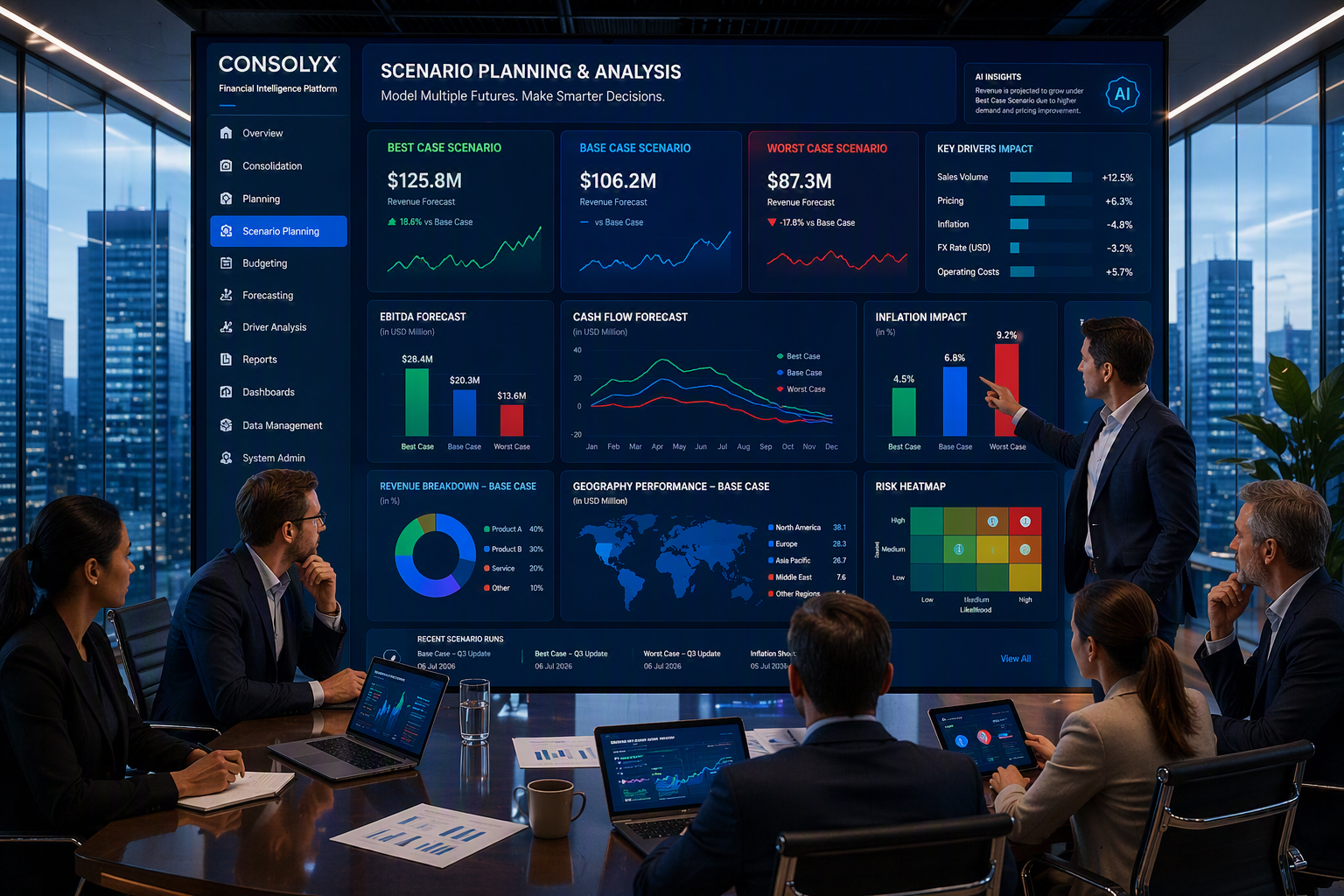
Scenario planning is a structured process that helps organizations evaluate different future business conditions and understand their potential financial impact.
Instead of relying on a single forecast, finance teams create multiple planning scenarios based on different assumptions.
For example:
Base Case Scenario
The business performs according to current expectations.
Best Case Scenario
Revenue growth exceeds expectations, costs remain stable, and market conditions improve.
Worst Case Scenario
Demand slows, inflation increases, foreign exchange rates become unfavorable, or operating costs rise significantly.
By understanding how each scenario affects revenue, profitability, cash flow, liquidity, and key performance indicators, leaders can make informed decisions before challenges arise.
Scenario planning is not about predicting the future.
It is about preparing for uncertainty.
Why Economic Uncertainty Requires a Different Approach
Many finance organizations continue to rely heavily on annual budgeting processes that were designed for more stable business environments.
The problem is that uncertainty does not wait for the next budgeting cycle.
A budget prepared in January may no longer reflect business realities by June.
When organizations rely solely on static budgets, management teams often find themselves reacting to events rather than proactively managing them.
Modern finance organizations are shifting toward:
- Rolling forecasts
- Driver-based planning
- Predictive analytics
- Scenario modeling
- Real-time performance monitoring
These capabilities allow finance teams to continuously evaluate risks and opportunities as conditions evolve.
The Future of Finance Leadership
The role of the CFO is evolving rapidly.
Finance leaders are no longer expected to simply report results after the fact.
They are expected to help shape strategy, identify risks, evaluate opportunities, and guide decision-making across the organization.
Scenario planning sits at the center of this transformation.
Organizations that embrace scenario planning gain more than better forecasts.
They gain agility.
They gain resilience.
Most importantly, they gain the ability to make better decisions during periods when uncertainty is highest.
In today's environment, that capability may be one of the most valuable competitive advantages a business can possess.
Final Thought
Economic uncertainty is unavoidable. Being unprepared for it is not.
The most successful organizations are not those that guess the future correctly. They are the organizations that prepare for multiple futures and build the flexibility to succeed in each of them.
For modern CFOs, scenario planning is no longer a planning exercise. It is a strategic necessity.