Why Carbon Accounting, AI and ESG Intelligence Platforms Are Becoming Boardroom Priorities
Carbon accounting has become a boardroom priority as investors, regulators, governments and customers demand reliable ESG information. Organizations now need auditable Scope 1, Scope 2 and Scope 3 data connected to climate risk, strategy and capital decisions. AI-powered ESG intelligence platforms help transform sustainability data into dashboards, insights, controls and action. CONSOLYX ESG brings carbon accounting, framework mapping, audit readiness, government monitoring and board reporting.
Who should read this: CFOs, Sustainability Directors, Government Leaders, ESG Managers, Investors, Board Members and Enterprise Strategy Teams.
Why This Matters Now
Organizations are facing increasing pressure from investors, customers, regulators and boards to provide sustainability information that is reliable, transparent, comparable and auditable. This pressure is no longer limited to annual ESG disclosures; it is becoming part of how leadership teams assess performance, risk, resilience and long-term value.
Carbon accounting is no longer simply an environmental exercise. It is becoming a strategic management discipline that influences capital allocation, procurement decisions, risk management, operational efficiency and long-term value creation. As global sustainability standards and climate disclosure expectations mature, organizations need stronger systems to collect, validate, calculate, explain and report carbon and ESG information with confidence.
Organizations that invest in ESG intelligence today will be better positioned for future compliance, investor confidence and sustainable growth. The advantage will not come only from reporting emissions; it will come from turning sustainability data into management insight, board-level visibility and practical action.
|
Pressure Area |
Why It Matters for Leadership |
|
Investors |
Require decision-useful ESG information linked to risk, cash flows, access to finance and long-term enterprise value. |
|
Regulators |
Expect structured, traceable and auditable sustainability disclosures aligned with emerging global reporting requirements. |
|
Customers and Supply Chains |
Increasingly assess supplier emissions, responsible sourcing, operational resilience and sustainability commitments. |
|
Boards and Executives |
Need visibility into climate risk, carbon performance, target progress, capital allocation and strategic accountability. |
Introduction
For many years, sustainability reporting lived at the edge of enterprise management. It was prepared annually, reviewed late in the reporting cycle and often treated as a narrative disclosure rather than a decision-making discipline. That model is changing quickly. Carbon emissions, energy efficiency, supplier exposure, regulatory compliance, climate risk and sustainability performance are now directly connected to enterprise value, access to capital, procurement eligibility, public accountability and board oversight.
Carbon accounting is no longer only about measuring emissions. It is about understanding how an organization consumes resources, manages risk, allocates capital, performs against targets and prepares for a lower-carbon economy. The organizations that lead in this area are not simply producing better ESG reports. They are building better management systems.
Carbon Accounting Has Entered the Boardroom
Boards are increasingly asking a different set of questions. They are not only asking whether the organization has published an ESG report. They are asking whether emissions data is complete, whether reduction targets are realistic, whether climate risk is reflected in strategy, whether suppliers create hidden exposure and whether sustainability commitments are supported by operating plans and capital decisions.
This shift is driven by regulation, investor pressure, customer expectations and the practical reality that carbon performance is linked to cost, resilience and competitiveness. A company with poor energy visibility may carry avoidable operating costs. A group with weak supplier data may face Scope 3 reporting gaps. A public authority without carbon visibility may struggle to monitor infrastructure, facilities and regional sustainability targets.
Understanding Scope 1, Scope 2 and Scope 3
In practical business language, Scope 1 emissions are the emissions an organization directly produces from assets it owns or controls, such as fuel used in factories, boilers, vehicles or operational equipment. Scope 2 emissions are indirect emissions from purchased electricity, steam, heating or cooling. Scope 3 emissions are the broader value-chain emissions created by suppliers, logistics, business travel, purchased goods, product use, waste and other upstream or downstream activities.
For leadership teams, the three scopes create a useful management lens. Scope 1 shows operational control. Scope 2 shows energy dependency. Scope 3 shows ecosystem exposure. Together, they reveal whether an organization is managing only its own buildings and vehicles, or whether it understands the full carbon profile of its business model.
For leadership teams, the three scopes create a useful management lens. Scope 1 shows operational control. Scope 2 shows energy dependency. Scope 3 shows ecosystem exposure. Together, they reveal whether an organization is managing only its own buildings and vehicles, or whether it understands the full carbon profile of its business model.
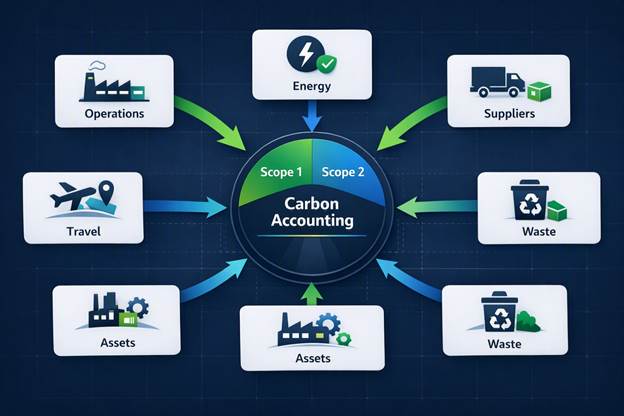
Caption: Understanding enterprise-wide carbon exposure across operations, energy, suppliers, travel, assets and waste.
Why Climate Risk Has Become a Business Risk
Climate risk is now part of enterprise risk management. Physical risks such as heat, floods, water stress and severe weather can affect operations, infrastructure, insurance costs and supply chains. Transition risks such as carbon pricing, regulation, customer preferences and technology shifts can affect margins, asset values and market access.
The practical question for executives is not whether climate risk exists. The question is whether the organization can identify where it sits in the business, quantify its potential impact and connect it to decisions on investment, procurement, operations and strategy.
ESG Risk Management: From Disclosure to Control
ESG risk management is becoming a formal part of enterprise governance. Organizations need to identify sustainability-related risks, assess their financial and operational impact, assign ownership, monitor controls and report progress to management and the board. This includes climate risk, carbon management, supplier exposure, regulatory compliance, data quality, health and safety, water stress, waste performance and broader sustainability intelligence.
For CFOs and boards, the discipline is similar to financial risk management. Risk registers, data owners, approvals, audit trails, target monitoring and exception reporting are required so that ESG information can be trusted. This is why enterprise ESG platforms must support both sustainability reporting and internal risk control, especially where IFRS S1, IFRS S2, CSRD, ESRS and GHG Protocol requirements influence disclosure expectations.
Why Investors Are Demanding Better ESG Intelligence
Investors are looking for decision-useful sustainability information. They want to understand how ESG risks and opportunities may affect cash flows, access to finance, cost of capital, resilience and long-term value. Frameworks such as IFRS S1 and IFRS S2 have reinforced this direction by connecting sustainability and climate-related disclosures with enterprise prospects, governance, strategy, risk management, metrics and targets.
For CFOs, this means sustainability data can no longer remain separate from financial planning, capital allocation and performance review. The same discipline applied to financial consolidation, audit trails and management reporting is now expected in carbon and ESG reporting.
The Growing Role of ESG Dashboards
Executive dashboards are becoming the bridge between sustainability data and management action. A board does not need thousands of rows of activity data. It needs clarity: emissions by scope, performance by entity, target versus actual, highest-risk facilities, energy intensity, Scope 3 exposure, compliance status and investment priorities.
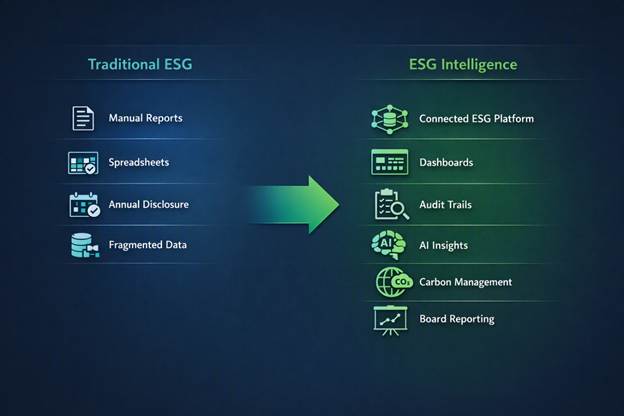
Caption: Moving from annual disclosure and manual reporting toward connected ESG data, dashboards, AI insights and management action.
How AI Is Transforming Sustainability Management
AI is changing sustainability management by helping organizations detect anomalies, identify missing data, compare performance patterns, explain variances, generate management insights and support scenario analysis. Used responsibly, AI can reduce manual effort and help sustainability teams move from data collection to interpretation.
However, AI does not replace governance. It depends on clean data, clear calculation logic, transparent assumptions and auditable workflows. The future belongs to platforms that combine AI insight with strong carbon accounting discipline.
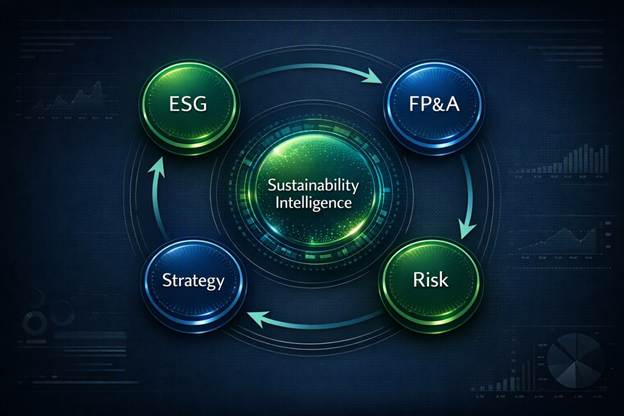
Caption: Connecting sustainability intelligence with financial planning, enterprise risk management and strategic decision-making.
Why Governments Need ESG Intelligence Platforms
Governments and public sector organizations need carbon visibility at a different scale. They must monitor facilities, regions, public assets, transport systems, utilities, waste, water, infrastructure and national or municipal sustainability targets. Annual reporting alone is not enough for this responsibility.
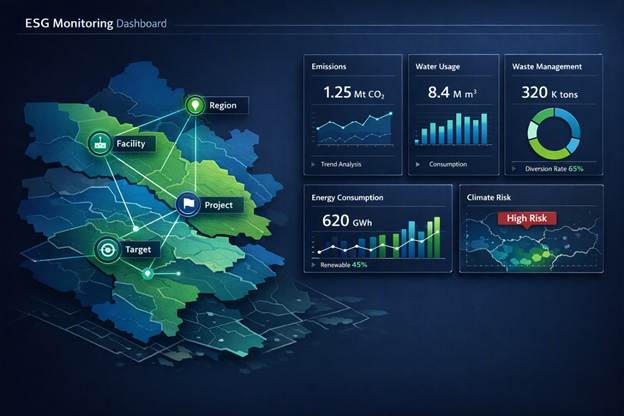
Caption: Map-based monitoring of regions, facilities, projects and sustainability targets.
The End of Spreadsheet-Driven Sustainability Management
Spreadsheets are useful for early-stage analysis, but they are not enough for enterprise sustainability management. As organizations grow across entities, countries, business units and suppliers, spreadsheet-based ESG processes create version-control issues, weak audit trails, inconsistent calculations and limited executive visibility.
[Graphic 6: CONSOLYX ESG Architecture]
Caption: Data sources, validation, carbon engine, framework mapping, reporting, dashboards, AI insight and board reporting.
What Leading Organizations Are Doing Differently
Leading organizations are building sustainability operating models, not just ESG reports. They define accountable data owners, connect ESG metrics to enterprise systems, validate activity data, maintain emission factors, map disclosures to reporting frameworks, monitor targets and provide dashboards for executives, operational teams and external stakeholders.
Beyond Compliance: ESG as a Competitive Advantage
ESG maturity creates practical business value. It supports better decisions, better risk management, stronger investor confidence, better procurement positioning, improved operational efficiency, stronger governance and long-term value creation. For enterprise groups, ESG intelligence can also support tender eligibility, lender confidence, supplier negotiations, strategic planning and board accountability.
Executive Tables
Why ESG Reporting Is Following the Path of Financial Reporting
|
Financial Reporting Discipline |
Emerging ESG Reporting Discipline |
|
Chart of accounts and reporting structures |
ESG categories, carbon scopes, emission factors and framework mapping |
|
Monthly closing and consolidation |
Periodic ESG data collection, validation and carbon calculation cycles |
|
Internal controls and audit trails |
Data ownership, approvals, evidence, exceptions and sustainability assurance readiness |
|
Management reporting and board packs |
ESG dashboards, climate risk views, net zero progress and sustainability intelligence |
|
External reporting under financial standards |
Disclosure alignment with IFRS S1, IFRS S2, CSRD, ESRS and GHG Protocol expectations |
|
Traditional Reporting |
Carbon Intelligence |
|
Annual disclosure exercise |
Continuous management discipline |
|
Periodic reporting |
Monthly, quarterly and real-time visibility |
|
Sustainability team audience |
Board, CFO, operations, investors and regulators |
|
Manual controls |
Data ownership, validation and audit trails |
|
Spreadsheets and documents |
Integrated platform, dashboards and AI insights |
|
Backward-looking narrative |
Forward-looking decision support |
|
Limited risk linkage |
Integrated climate and enterprise risk view |
|
Low executive visibility |
Board-ready performance dashboards |
|
Area |
Board Question |
Required Dashboard View |
|
Carbon Emissions |
Where are emissions highest? |
Scope-wise emissions by entity, site and period |
|
Climate Risk |
Which assets are exposed? |
Physical and transition risk heatmap |
|
Net Zero Targets |
Are we on track? |
Target versus actual trajectory |
|
Compliance |
What must we report? |
Framework and disclosure readiness status |
|
Investment Priorities |
Where should capital go first? |
Abatement cost and impact ranking |
|
Energy Performance |
Where are efficiency gaps? |
Energy intensity by facility and activity |
|
Scope 3 Exposure |
Where is supplier risk concentrated? |
Supplier, category and region exposure view |
|
Area |
Example |
Business Value |
|
Energy |
Monitor electricity use across public buildings |
Lower utility cost and improve efficiency |
|
Transport |
Track fleet fuel and mobility emissions |
Support cleaner transport planning |
|
Waste |
Measure landfill, recycling and treatment data |
Improve circular economy performance |
|
Water |
Monitor water consumption and stress exposure |
Strengthen resource resilience |
|
Infrastructure |
Assess emissions from capital projects |
Improve climate-aware investment decisions |
|
Public Assets |
Compare facilities, regions and agencies |
Improve accountability and target monitoring |
|
Future ESG Intelligence Stack |
Role |
|
Source Data |
Energy, fuel, waste, water, procurement, travel, assets and operations |
|
Validation |
Completeness checks, ownership, approvals and exception review |
|
Carbon Engine |
Emission factors, formulas, scopes and calculation logic |
|
Framework Mapping |
ISSB, GRI, regulatory and internal reporting alignment |
|
Reporting |
Structured outputs for management, regulators and stakeholders |
|
Dashboard |
Executive visibility by entity, scope, period and target |
|
AI Insights |
Anomaly detection, variance explanation and recommendations |
|
Board Reporting |
Strategic view of risk, performance and accountability |
Practical Enterprise Examples
Example 1: Manufacturing Company. A manufacturing group can use carbon intelligence to connect production volumes, energy consumption, fuel usage, process emissions and supplier inputs. This helps management identify high-emission plants, improve efficiency, prioritize investments and support customer sustainability requirements.
Example 2: Utility Organization. A utility can monitor generation mix, energy losses, asset performance, renewable transition plans and regulatory commitments. ESG dashboards can help leadership compare targets with actual results and communicate progress with greater confidence.
Example 3: Government Agency. A government agency can track emissions across buildings, transport fleets, public infrastructure, waste systems and regional programs. This creates a more transparent basis for policy decisions, budget allocation and public accountability.
Example 4: Healthcare Group. A healthcare group can monitor energy-intensive facilities, medical waste, procurement categories, refrigerants and supply-chain exposure. Carbon intelligence can support resilience, cost management and responsible procurement.
Example 5: Large Holding Company. A diversified holding company can consolidate ESG performance across subsidiaries, countries and sectors. This enables group-level reporting while preserving entity-level accountability and operational ownership.
Why CONSOLYX ESG Is Built for the Future
CONSOLYX ESG is designed for organizations that need more than a static ESG report. It supports enterprise ESG, sustainability intelligence and carbon management across Scope 1, Scope 2 and Scope 3, framework mapping, target versus actual performance, dashboard analytics, AI insights, government monitoring, ESG risk management, audit readiness, multi-entity structures, multi-country operations and integration with FP&A and financial consolidation.
The Future of ESG Intelligence
The future of ESG intelligence will be defined by connected data, stronger governance, automated calculation engines, real-time dashboards, AI-supported insights and closer integration with financial and operational planning. ESG will increasingly sit beside revenue, cost, cash flow, risk and capital as a core management discipline.
The Next Era of Sustainability Intelligence
The next era will combine AI, digital ESG reporting, real-time carbon management, board accountability, government monitoring, climate risk intelligence, sustainability performance management and enterprise decision intelligence. The winners will be organizations that treat ESG not as a reporting burden, but as a management capability.
Conclusion
Carbon accounting, AI and ESG intelligence platforms are becoming boardroom priorities because sustainability now affects strategy, risk, capital, regulation, investor confidence and operational performance. The question for leaders is no longer whether they should measure emissions. The question is whether they can govern, explain and act on sustainability data with the same discipline expected from enterprise financial information.