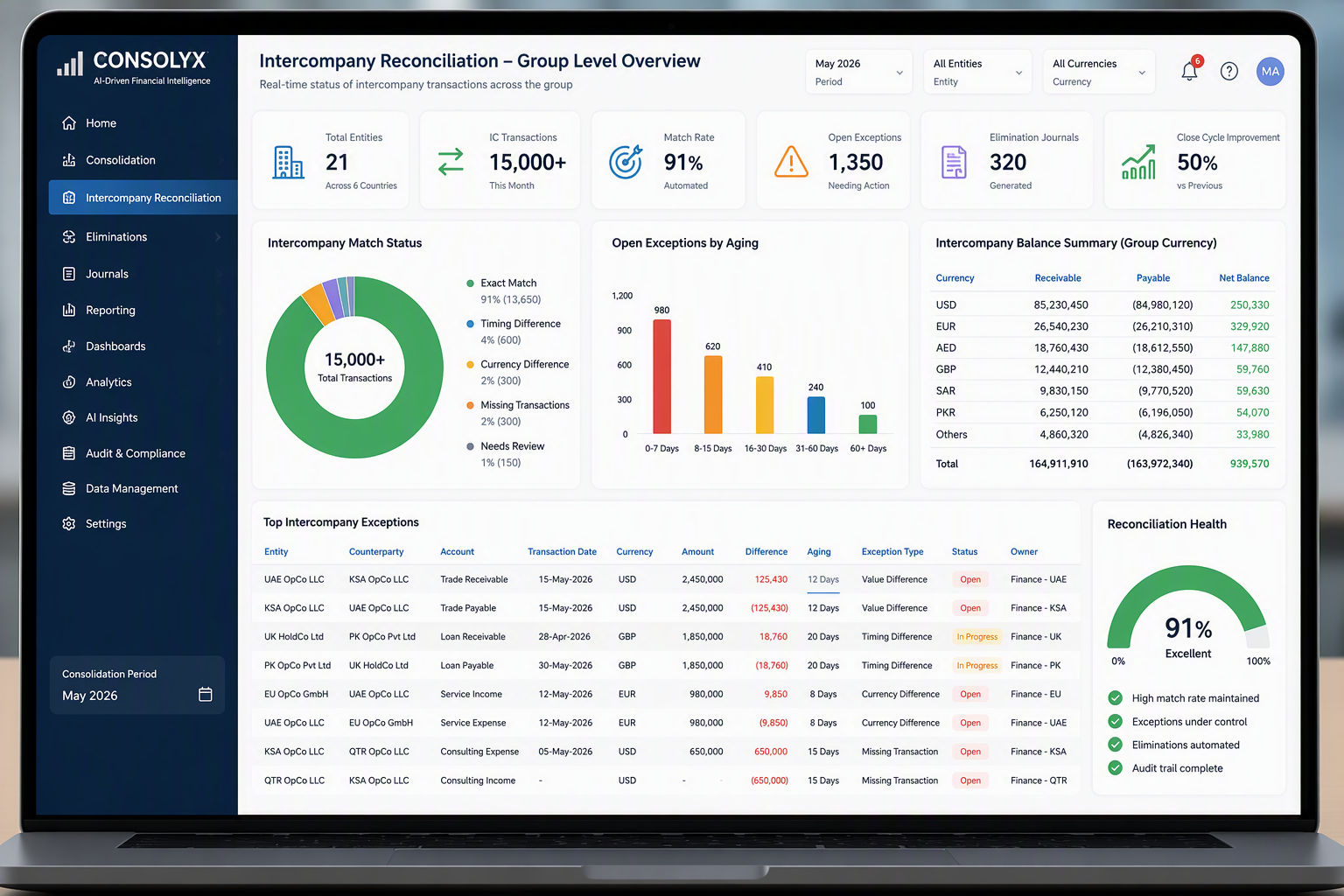
Intercompany Reconciliation & Elimination Automation
Intercompany reconciliation has become a recurring financial close constraint for a multi-country group operating across 6 countries, 21 entities, 7 currencies, and more than 15,000 monthly intercompany transactions. Timing differences, foreign exchange movements, missing counterpart entries, and manual follow-up delayed month-end close activities and reduced confidence in consolidated numbers.
Intercompany Transformation at a Glance
|
Countries |
Entities |
Currencies |
Monthly IC Transactions |
|
IC Relationships |
Finance Users |
Financial Close Impact |
Platform |
CONSOLYX was implemented as a financial consolidation and group reporting platform to centralize intercompany matching, automate elimination journals, standardize multi-currency controls, and improve audit readiness. The result was a 91% automated match rate, 50% faster close-cycle effort, stronger group reporting control, and better CFO visibility before board reporting.
CFO Perspective: The value of consolidation automation is not only speed. It is the ability to explain numbers earlier, resolve exceptions before reporting pressure builds, and give leadership a trusted view of group performance.
Business Outcomes
· ✓ 15,000+ intercompany transactions processed monthly through one controlled workflow
· ✓ 21 entities connected into a standardized corporate consolidation model
· ✓ 91% automated intercompany matching rate achieved
· ✓ Elimination journals automated using controlled rules and approval logic
· ✓ Financial close effort reduced by 50%
· ✓ Month-end close visibility improved for CFO and group controller teams
· ✓ multi-currency reconciliation standardized across 7 currencies
· ✓ Audit readiness improved through traceable evidence and review ownership
· ✓ Real-time exception monitoring introduced for unresolved differences
· ✓ Consolidation confidence increased before board and audit committee reporting
Why This Transformation Was Different
This transformation did not treat intercompany reconciliation as a spreadsheet clean-up exercise. It positioned reconciliation as a core control layer inside group reporting, financial close, corporate consolidation, and board reporting.
CONSOLYX connected entity submissions, counterparty matching, exception ownership, elimination rules, audit evidence, and CFO dashboards in one workflow. This reduced dependency on email follow-up and shifted finance teams from manual checking to exception-based review.
Why This Matters
Intercompany reconciliation is one of the biggest hidden causes of delayed close cycles. While external stakeholders rarely see it, unresolved intercompany differences create delayed reporting, audit challenges, reduced trust in numbers, increased finance effort, and lower management confidence. Leading finance teams solve reconciliation before they improve reporting, because clean intercompany balances are the foundation of reliable consolidation.
Executive Takeaway: Leading finance teams do not wait until consolidation to discover intercompany problems. They solve matching, ownership, currency differences, and eliminations before group reporting begins.
Before vs After Transformation
|
Before CONSOLYX |
After CONSOLYX |
|
Process: Multiple spreadsheets, disconnected submissions, and manual matching. Control: Email-based follow-up, weak evidence trail, and late issue escalation. Close Impact: Delayed reconciliation, manual eliminations, and recurring currency differences. |
Process: Centralized intercompany matching and standardized corporate consolidation workflow. Control: Exception ownership, audit-ready traceability, and controlled elimination rules. Close Impact: Faster month-end close, dashboard visibility, and improved confidence in group reporting. |
Intercompany Reconciliation Operating Model
Intercompany Reconciliation Flow
ERP Systems → Transaction Upload → Intercompany Matching → Exception Review → Elimination Rules → Corporate Consolidation → Group Reporting
Internal Design Guidance: Use a simple consulting-style visual only. Keep it clean, flat, and professional. Avoid AI-looking graphics, excessive 3D effects, cartoons, or clutter. Approved visuals: CFO Close Command Center, Intercompany Reconciliation Flow, Match Rate Waterfall, Close Cycle Improvement Chart, Reconciliation Maturity Model, and CONSOLYX Consolidation Architecture.
CONSOLYX Consolidation Architecture
Source Systems → Data Validation → Matching Engine → Workflow Controls → Elimination Journals → Consolidated Reporting → CFO Close Command Center
· ERP Systems: Source ledgers provide intercompany receivables, payables, income, expense, loan, allocation, and settlement records.
· Transaction Upload: Entity-level data is uploaded into a controlled consolidation environment with period, entity, counterparty, currency, and account validation.
· Matching Engine: CONSOLYX compares both sides of each relationship and categorizes results into exact matches, timing differences, currency differences, value differences, and missing transactions.
· Exception Analysis: Unmatched items are prioritized by value, age, entity, counterparty, currency, and reporting impact.
· Workflow Review: Finance users review exceptions, provide explanations, attach evidence, and confirm resolution ownership.
· Elimination Rules: Approved intercompany balances and transactions are converted into controlled elimination journals.
· Consolidation: Cleaned and eliminated balances flow into group reporting with reduced manual intervention.
· Board Reporting: CFOs and executive teams receive consolidated numbers supported by traceable reconciliation evidence.
Reconciliation Categories
|
Category |
Definition |
Action |
|
Exact Match |
Both entities record the same transaction value in the same period and currency logic. |
Auto-confirm and move to elimination readiness. |
|
Timing Difference |
One side is recorded in a different reporting period. |
Flag for period review and follow-up. |
|
Currency Difference |
Difference arises from exchange rate, transaction currency, or reporting currency conversion. |
Validate rate source and calculate currency impact. |
|
Value Difference |
Both sides exist but recorded values do not agree. |
Assign to entity owners for investigation. |
|
Missing Transaction |
One entity records a transaction but the counterparty does not. |
Escalate to counterparty finance team. |
|
Manual Review |
Complex or judgment-based items requiring finance review. |
Route through workflow with supporting explanation. |
Results Dashboard KPIs
|
KPI |
Monthly Value |
Executive Meaning |
|
Transactions Processed |
15,000+ |
High-volume reconciliation handled through one controlled model. |
|
Automated Match Rate |
91% |
Finance effort shifted from manual matching to exception review. |
|
Timing Differences |
4% |
Period cut-off issues became visible earlier in the financial close. |
|
Currency Differences |
2% |
FX-related variances were separated from operational mismatches. |
|
Missing Transactions |
2% |
Counterparty gaps were routed for ownership and resolution. |
|
Manual Review |
1% |
Only judgment-based items required detailed finance review. |
CFO Close Command Center
Open Exceptions | Match Rate | Entity Status | Currency Differences | Elimination Readiness | Close Progress
Match Rate Waterfall
15,000+ Transactions → 91% Exact Matches → 4% Timing Differences → 2% Currency Differences → 2% Missing Transactions → 1% Manual Review
Close Cycle Improvement Chart
Before: Manual Reconciliation and Late Eliminations → After: Automated Matching, Controlled Exceptions, and 50% Faster Close
Audit Readiness Benefits
· Traceable reconciliation status by entity, counterparty, currency, and reporting period.
· Documented exception ownership and review evidence.
· Clear separation between timing, currency, value, and missing transaction differences.
· Controlled elimination journal logic linked to approved reconciliation outcomes.
· Reduced last-minute audit evidence gathering during financial reporting transformation.
Audit Perspective: A strong intercompany process gives auditors a clearer trail from source transaction to match status, exception resolution, elimination entry, and consolidated reporting impact.
Reconciliation Maturity Model
|
Level |
Maturity Stage |
Finance Characteristics |
|
1 |
Manual |
Spreadsheet matching, email follow-up, and limited audit trail. |
|
2 |
Standardized |
Common templates, defined ownership, and periodic reconciliation discipline. |
|
3 |
Automated |
Intercompany matching rules, exception dashboards, and controlled review workflows. |
|
4 |
Integrated |
Reconciliation connected with elimination journals, corporate consolidation, and group reporting. |
|
5 |
Predictive |
Trend-based exception detection, continuous close monitoring, and proactive CFO visibility. |
Reconciliation Maturity Model
Manual → Standardized → Automated → Integrated → Predictive
Managing Reconciliation Across Seven Currencies
Multi-currency intercompany reconciliation requires more than translating balances at month end. It requires a controlled view of transaction currency, local currency, group reporting currency, exchange rate source, rate type, and the timing of recognition. CONSOLYX standardizes this process by separating true transactional mismatches from foreign exchange differences, allowing finance teams to identify whether a variance is caused by recording error, timing difference, rate movement, or policy treatment.
This improves both close efficiency and audit confidence, because currency differences are no longer hidden inside unexplained reconciliation gaps. Instead, they become visible, categorized, and explainable before elimination journals are generated.
Future Trend: Intercompany reconciliation is moving toward continuous close, predictive exception detection, and AI-assisted variance explanation. The finance function is shifting from transaction checking to control oversight and business insight.