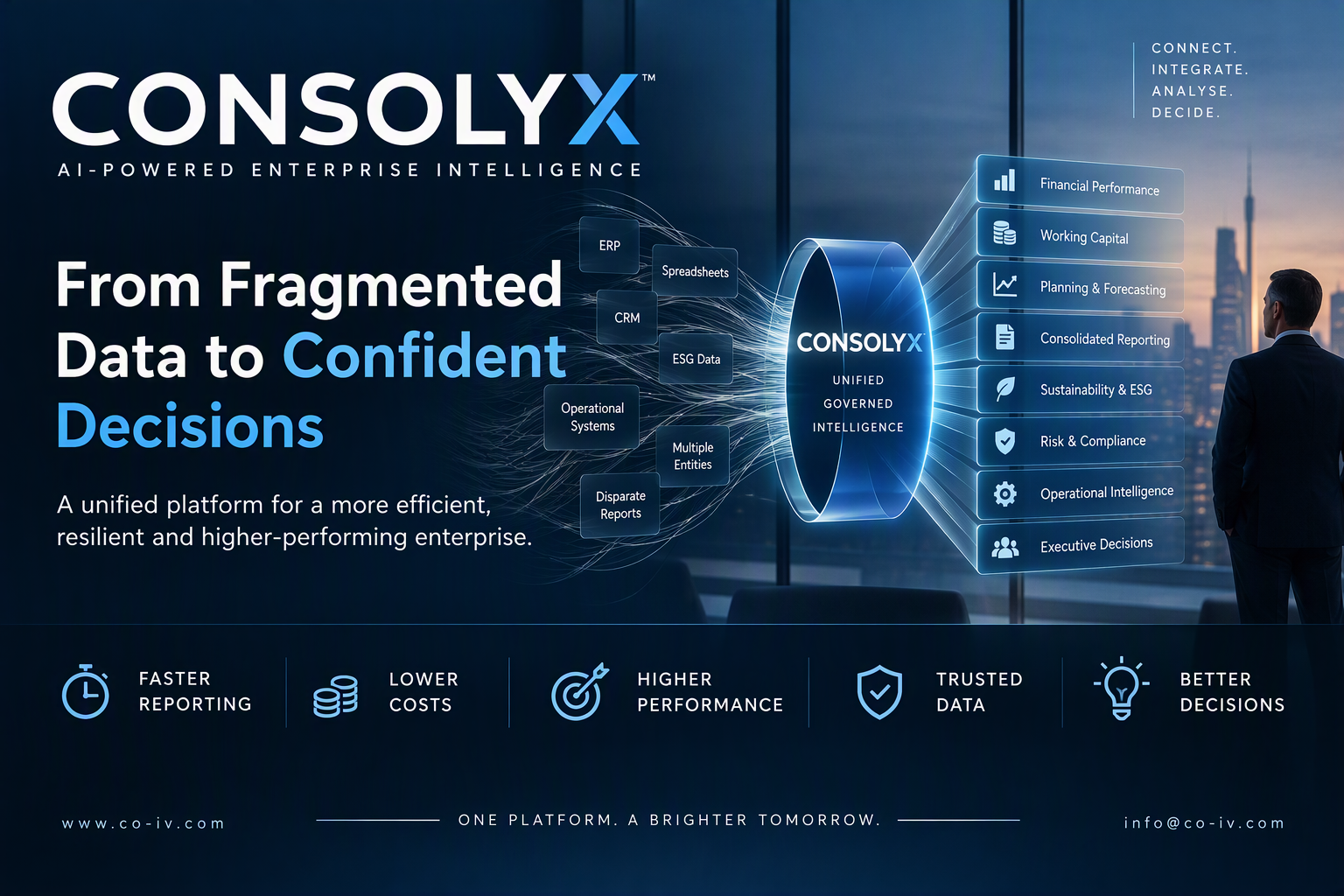
AI-Powered Enterprise Intelligence: The End of Fragmented Decision-Making
How a unified enterprise intelligence platform helps Group CFOs, CEOs and boards accelerate reporting, strengthen cost control and make faster, evidence-based decisions.
Data is everywhere. Decision-grade intelligence is not.
The competitive gap is increasingly defined by how quickly an organization can connect trusted data to accountable action.
The Enterprise Problem Has Changed
Most enterprises do not need another isolated dashboard. They need a governed way to connect financial, operational, planning, sustainability, risk and relationship data across the group.
A multinational organization may operate through many entities, countries, currencies, jurisdictions and source systems. Each entity prepares its own reports. Group reporting teams reshape submissions. FP&A rebuilds assumptions. Operations maintains separate performance views. Sustainability and risk teams collect additional evidence. Audit and board requirements create another reporting cycle.
The work is necessary, but the architecture is often fragmented. The same facts are repeatedly extracted, mapped, reconciled, reformatted and explained. Leaders receive more information, yet the distance between an operating event and an executive decision remains too long.
The Cost of Delayed Decisions
A delayed decision can cost more than a delayed report. When management sees margin pressure, cash constraints, cost overruns or operational exceptions only after period-end, the organization loses time to respond.
Decision latency affects more than reporting speed. It can delay corrective action, capital reallocation, collection efforts, pricing decisions, inventory responses and project interventions. The value of enterprise intelligence is therefore not simply faster reporting. It is earlier action supported by a traceable version of performance.
Why Group CFOs and Boards Need One Governed View
The modern Group CFO is responsible for far more than financial close. Capital allocation, liquidity, performance, planning, investment evaluation, risk, governance and strategic guidance increasingly meet in the finance function.
Boards need to move from questions such as 'What happened?' to 'Why did it happen, what is likely to happen next, and what decision is required now?' That requires a consistent view from group to entity, node, business unit, project and transaction, without losing the local context beneath the group result.
ENTERPRISE DATA → GOVERNED INTELLIGENCE → EXECUTIVE ACTION
One connected decision path across the enterprise.
From Systems of Record to a Unified Intelligence Layer
Enterprise Intelligence is the governed layer between source systems and executive decisions. It is designed to complement ERP, accounting, CRM, operational and specialist applications, not force a costly rip-and-replace program.
Authorized data can be connected through files, APIs, databases and controlled integrations. Common structures, mappings, calculations, workflows, approvals, evidence and audit trails then convert that data into reusable intelligence for reporting, planning, performance management and decision support.
This changes the operating model. Instead of every function rebuilding its own view, teams can work from the same governed backbone while retaining the detail, methodology and accountability required for their role.
What a Unified Enterprise Intelligence Platform Connects
|
Financial Consolidation |
Multi-entity and multicurrency reporting, ownership structures, intercompany matching, eliminations and consolidated financial statements. |
|
FP&A Intelligence |
Budgets, driver-based forecasts, rolling forecasts, scenarios, sensitivity analysis, investment modelling and variance intelligence. |
|
Operational Intelligence |
Sales, inventory, procurement, payroll, receivables, payables, banking, production, projects and performance drivers. |
|
Sustainability Intelligence |
ESG, carbon, climate, sustainability, ESRM, controlled evidence, workflows, framework mapping and assurance preparation. |
|
Relationship Intelligence |
Customers, opportunities, activities, communications and relationship signals connected to enterprise outcomes. |
|
Executive Decision Intelligence |
Group visibility, exceptions, scenarios, drill-down analysis and traceable AI-assisted insight for management and boards. |
Working Capital: Where Visibility Becomes Action
Working capital exposes the practical value of a unified platform. Cash, receivables, payables and inventory may sit across different entities, banks, ERPs and operating systems. A group-level view should not depend on a manual month-end exercise.
When those components are connected, leadership can examine where cash is concentrated, which entities are carrying collection pressure, where payment obligations are building, how inventory is affecting liquidity and which operational drivers are changing the cash conversion cycle.
The objective is not merely to display working-capital metrics. It is to connect them to accountable entities, customers, suppliers, inventory movements, forecasts and actions.
From Reporting Cost to Strategic Capacity
Reporting cost is not limited to software licenses. It includes repeated data preparation, reconciliation, rework, version control, explanation and management attention. Fragmentation also consumes the capacity of finance, reporting, audit, planning and operational teams.
A unified model can reduce avoidable duplication by reusing approved structures, mappings, workflows and calculations across recurring processes. The benefit is not indiscriminate headcount reduction. It is the release of skilled capacity from repetitive assembly toward analysis, intervention and value creation.
What Better Enterprise Intelligence Enables
Faster, more controlled reporting
Reusable structures and automated workflows reduce repeated aggregation and reconciliation.
Stronger cost optimization
Group and entity views help leadership identify duplication, exceptions and cost drivers before action is delayed.
Better capital allocation
Actual performance, forecasts, scenarios and investment assumptions can be assessed on a consistent basis.
Improved performance management
Financial results can be connected to operational drivers, accountable owners and corrective actions.
Greater board confidence
Figures and insights can remain linked to source data, methodology, evidence, workflow and approval.
Scalable transformation
Organizations can begin with one priority and extend through connected modules without recreating the decision backbone.
Why Enterprise AI Needs Governed Intelligence
AI does not remove the need for structure, controls or human judgment. It increases their importance. AI-assisted commentary, anomaly detection, forecasting support and exception prioritisation become more useful when the underlying data is validated, consistently defined and traceable.
For CFOs, AI investment is increasingly tied to measurable outcomes, scalable economics, governance and risk. Deloitte describes CFOs as instrumental in organization-wide AI decisions and highlights the need to anchor AI initiatives to measurable business outcomes and governance. Source: Deloitte CFO Insights, March 18, 2026.
The objective is not uncontrolled automation. It is governed augmentation: helping leaders identify what requires attention, understand why it matters, test alternatives and act with stronger evidence.
A Practical Transformation Path
A unified platform does not need to begin as a disruptive enterprise-wide replacement program. The stronger path is to begin with a material business priority, establish a measurable baseline and then scale the governed backbone.
|
1. Select the priority Group reporting, FP&A, working capital, operational performance, sustainability intelligence or another decision-critical use case. |
|
2. Establish the baseline Document current cycle time, handoffs, reconciliations, systems, controls, pain points and decision requirements. |
|
3. Connect and govern Configure approved structures, source connections, mappings, calculations, workflows, evidence and access. |
|
4. Prove the outcome Measure improvements against the baseline, including reporting effort, exception visibility, decision speed and control quality. |
|
5. Scale the backbone Extend connected intelligence domains without rebuilding the same foundations. |
The CONSOLYX Vision
CONSOLYX is being developed as an AI-powered Enterprise Intelligence Platform spanning Financial Consolidation, FP&A, Operational Intelligence, ESG, Carbon, Climate, Sustainability, ESRM, Relationship Intelligence and Executive Decision Intelligence.
CONSOLYX complements existing enterprise systems. It connects authorized data through a common governed structure so organizations can progress from fragmented reporting to faster, more accountable decisions.
The value is not another layer of disconnected technology. The value is one scalable decision backbone that supports standalone companies and complex groups, from local operations to consolidated board reporting.
ONE PLATFORM. ONE GOVERNED STRUCTURE. DECISIONS WITH CONTEXT.
Transforming data into intelligence, intelligence into decisions, and decisions into performance.
info@co-iv.com | www.co-iv.com