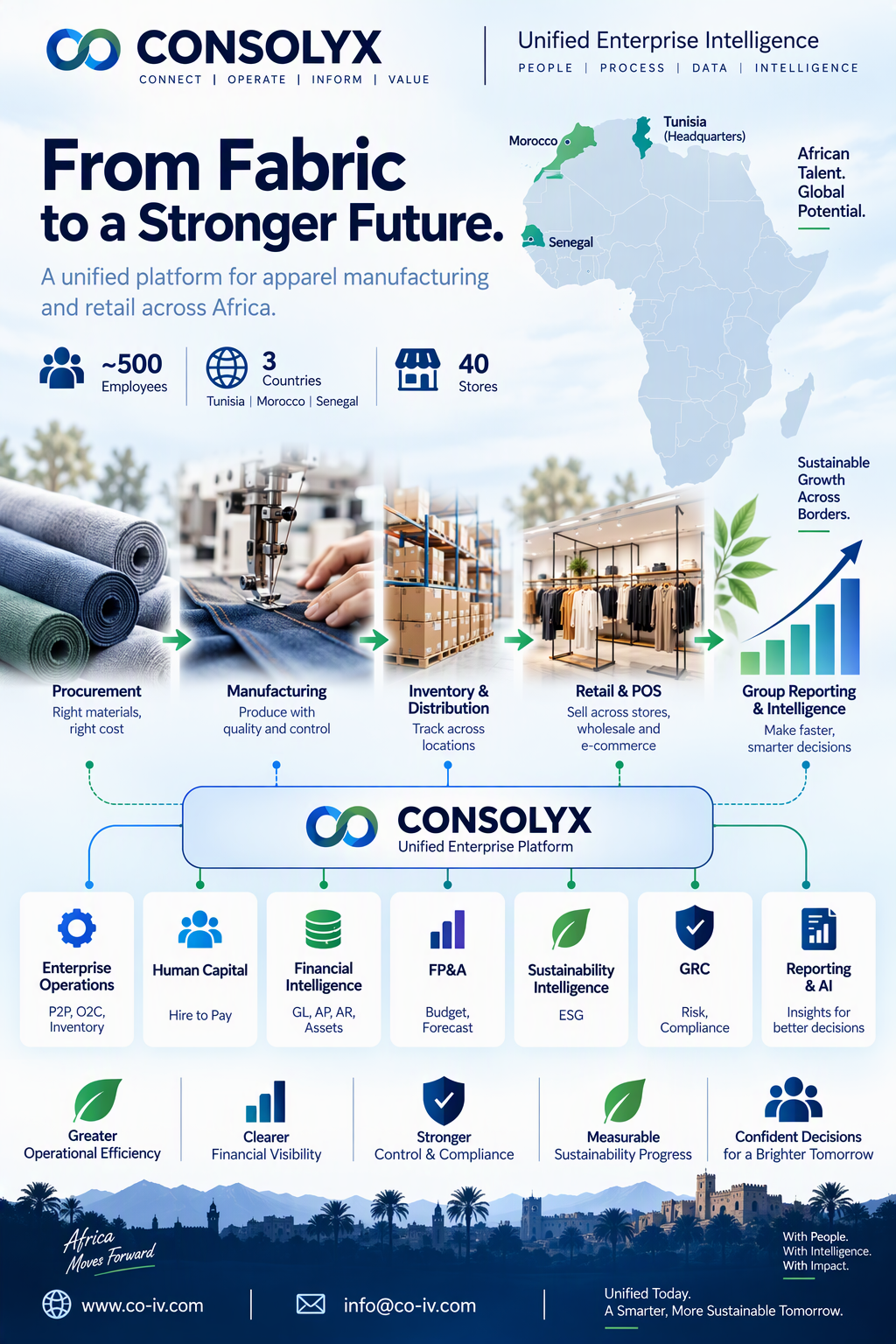
CONSOLYX for apparel manufacturing and retail
An apparel manufacturer and retailer with around 500 employees, headquartered in Tunisia and operating across Tunisia, Morocco and Senegal. This use case illustrates how CONSOLYX, configured to the client’s operating model, could connect production, inventory and sales with group reporting, planning and sustainability.
CONSOLYX for apparel manufacturing and retail
A Tunisian group operating across three African markets
An apparel manufacturer and retailer with around 500 employees, headquartered in Tunisia and operating across Tunisia, Morocco and Senegal. This use case illustrates how CONSOLYX, configured to the client’s operating model, could connect production, inventory and sales with group reporting, planning and sustainability.
All company details, transactions, exchange rates, figures, targets and expected outcomes below are hypothetical. They illustrate a proposed configuration and do not represent a customer deployment or achieved results.
The apparel group at a glance
|
Dimension |
Scenario assumption |
|
Workforce |
Approximately 500 employees across the group |
|
Legal structure |
1 parent company and 6 operating entities |
|
Footprint |
Tunisia headquarters and production; distribution and retail sites in Tunisia, Morocco and Senegal |
|
Physical network |
2 production facilities in Tunisia; 3 distribution centres, one per country; 40 stores: 20 in Tunisia, 12 in Morocco and 8 in Senegal |
|
Scale |
TND 300 million annual revenue and TND 60 million inventory |
|
Channels |
Retail stores, wholesale and e-commerce |
|
Currencies |
Tunisian dinars (TND), Moroccan dirhams (MAD) and West African CFA francs (XOF); group reporting in TND and selected purchases in euros (EUR) |
The business challenge
Each country can report its own activity, but management must reconcile inventory, product costs, payment settlements and intercompany trade to produce a reliable group view. Workforce, energy and control evidence are held in separate records.
What management needs to know
Can the group explain what it has produced, sold and collected across all three countries, understand the drivers of profit and risk, and approve the next action using the same underlying records?
02 Platform capabilities
How CONSOLYX could connect the business
The table pairs capability areas described on the CONSOLYX website with proposed applications for this illustrative group. [1–4]
|
Capability area |
Application in this group |
|
Enterprise Operations |
Connect purchasing, inventory, production, point-of-sale (POS) and wholesale sales, payment settlements, workforce costs and assets with approved operational and financial records. |
|
Financial Intelligence |
Bring country accounts into a common group model, translate currencies, reconcile intercompany activity and trace consolidated figures back to source records. |
|
Financial planning and analysis (FP&A) |
Compare actual performance with budgets and forecasts. Test assumptions about purchase rates, prices, volumes, staffing, cash and capital expenditure. |
|
Sustainability Intelligence |
Collect site energy, fuel and relevant supplier activity data; apply approved methods and factors; compare performance with targets and retain evidence. |
|
Governance, risk and compliance |
Assign owners to obligations, risks, controls and exceptions. Keep approvals, supporting records and corrective actions connected. |
|
Reporting and AI assistance |
Give executives scoped views of results and exceptions. Use authorised AI assistance to explore the supporting figures and explain movements. |
Shared records across the group
Use consistent identifiers for entities, sites, products, employees and counterparties, with approved reporting definitions and access rights. Existing accounting, point-of-sale or operational systems can remain part of the agreed architecture.
What to confirm before implementation
Confirm how manufacturing, supply-chain and retail workflows will be configured to the client’s operating model. Validate the selected modules, system interfaces, data refresh frequency, country-specific requirements and deployment approach before committing to the proposed operating model. [2, 5]
03 Operating journey
From fabric purchase to store sale
A seasonal replenishment request starts a 1,000-set apparel batch in Tunisia. The wider group uses the same operating definitions as goods move between facilities, country entities and sales channels.
|
Owner or process |
Proposed workflow and record |
|
Buyer |
Approve the EUR purchase order, receive and inspect fabric, match the supplier invoice and schedule payment. |
|
Warehouse team |
Record material locations and inventory issues, receive finished goods, and track transfers, returns, damage and quarantine. |
|
Production planner |
Link the bill of materials, production order, material consumption, labour, machine time and overhead to accepted output. |
|
Contract owner |
Reconcile fabric issued to a finishing contractor with accepted output, approved rates, invoices and rejected work. |
|
Country distribution |
Track dispatch, goods in transit, receipt and intercompany documentation across Tunisia, Morocco and Senegal. Retain each site and entity reference. |
|
Retail and wholesale |
Connect POS and wholesale sales, payment/tender records, orders and invoices with inventory issues and customer balances. |
|
Treasury |
Match expected receipts and payments with bank and payment provider records; explain fees, timing differences and unmatched amounts. |
|
Group controller |
Validate country submissions, map accounts, apply approved currency rules and eliminate internal activity for group reporting. |
Workforce and assets
For the 500-person workforce, the proposed view links approved headcount and workforce costs to each site, department and plan. Asset records support production capacity, maintenance and capital investment decisions. Local payroll calculations and interfaces require country-specific validation.
Give each exception an owner
A rejected contractor batch is excluded from accepted output until the issue is resolved. A card settlement shortfall remains open until treasury explains the difference. Each exception retains its evidence, responsible person and approval history.
04 Cost and scenario example
Production costs and margin planning
This example covers one Tunisian production batch of 1,000 accepted apparel sets. Each set is one unit for costing and sales. It assumes no abnormal waste or production variance; selling prices exclude tax.
|
Cost component |
TND |
|
Landed material, including normal waste |
69,000 |
|
Labour |
10,500 |
|
Machine |
3,750 |
|
Production overhead |
5,250 |
|
Contract finishing |
7,500 |
|
Total finished-goods cost |
96,000 |
Material cost = EUR 20,000 × an assumed TND 3.00 per EUR + TND 9,000 of local inputs and freight. These rates are planning assumptions, not market quotations.
How a higher euro exchange rate affects the margin
|
Measure |
Base purchase |
New purchase |
|
Assumed TND per EUR |
3.00 |
3.15 |
|
Batch cost |
TND 96,000 |
TND 99,000 |
|
Unit cost |
TND 96 |
TND 99 |
|
Net selling price |
TND 160 |
TND 160 |
|
Gross margin |
40.0% |
38.1% |
Base unit cost = TND 96,000 ÷ 1,000 = TND 96. Gross margin = (TND 160 − TND 96) ÷ TND 160 = 40.0%.
A 5% rise in the assumed TND cost of EUR increases the new batch cost by TND 3,000. This applies to a new purchase and does not revalue existing inventory.
Compare pricing and sourcing options
At a TND 99 unit cost, a TND 165 net price restores a 40.0% gross margin before any demand effect. Finance and commercial teams compare repricing, sourcing and volume options, then approve a scenario with clearly documented assumptions.
05 Financial intelligence
From stock and cash to group reporting
First, reconcile the sample batch. Assume 100 units are sold externally in Tunisia at TND 160 each, using the base unit cost. There are no returns or discounts, and these simplified amounts exclude tax.
|
Sample record |
Calculation |
TND |
|
Net external sales |
100 × TND 160 |
16,000 |
|
Cost of goods sold |
100 × TND 96 |
9,600 |
|
Product gross profit |
16,000 − 9,600 |
6,400 |
|
Remaining inventory |
900 × TND 96 |
86,400 |
The assumed tender split is TND 8,000 in cash and TND 8,000 by card. A hypothetical TND 160 card fee leaves TND 7,840 in the bank. Record payment provider and banking fees separately from sales revenue and product cost; product gross profit is distinct from group operating profit and net profit.
Consolidate results across three countries
The separate monthly example below uses TND reporting equivalents after approved currency translation. It is not an extrapolation of the 100-unit sale.
|
Group reporting step |
TND million |
|
Tunisia entities including TND 3m of internal sales |
15 |
|
Morocco entities |
8 |
|
Senegal entities |
5 |
|
Combined entity sales |
28 |
|
Eliminate matching internal sales |
−3 |
|
Consolidated external revenue |
25 |
The TND 3 million elimination avoids counting internal sales as group revenue. The controller also reconciles intercompany balances and checks for any profit remaining in unsold inventory. The sample batch separately assumes internal transfers at cost.
Plan from the reconciled figures
Compare country margins and cash needs, test collection or purchasing delays, and assess a new store or capital investment against the approved forecast. Detailed inventory, receivables and payment settlement views require transaction data; trial balances alone cannot supply them.
06 Sustainability and governance
Sustainability reporting and control evidence
The shared site and entity structure could also organise sustainability information and controls across Tunisia, Morocco and Senegal. [1, 4]
Sustainability measures and evidence
|
Operational record |
Proposed use |
Review needed |
|
Factory and store electricity |
Compare site energy use and cost; calculate emissions within the agreed reporting scope. |
Approved activity data, reporting boundaries, units and applicable factors |
|
Fuel and transport activity |
Track owned or controlled sources and relevant value-chain activity without double counting. |
Ownership, reporting category, method and supporting records |
|
Workforce and site measures |
Review training, safety or other selected indicators alongside site performance. |
Defined measures, owners, authorised access and evidence |
|
Efficiency investment |
Compare a proposed equipment upgrade with its cost, energy assumptions and expected reductions. |
An approved financial scenario and a measurable baseline |
Calculate emissions only from approved activity data and applicable factors within agreed reporting boundaries. Missing information remains a visible gap. Local disclosure outputs depend on configured and validated country-specific requirements.
Keep controls and approvals traceable
|
Control point |
Evidence and accountable action |
|
Supplier and contractor approval |
Keep approvals, receipts, quality acceptance records and invoices together; assign an owner to discrepancies. |
|
Country close and adjustments |
Separate preparation, review and approval. Retain mappings, supporting records and the approved version. |
|
Site obligations and risks |
Record the applicable obligation or risk, owner, due date, evidence and corrective action. |
|
Access and exceptions |
Limit information to authorised users and track unresolved findings through closure. |
If a site reports unusual energy use, the site manager checks the meter record, the sustainability owner reviews the units and factors, and finance assesses the cost variance. Management then approves an action and monitors the result.
07 Executive intelligence
Support decisions and assess value
An executive view should connect the group result with its supporting country, site and transaction records. Illustrative questions include why a country’s margin changed, which intercompany items remain open, and which sites missed an approved energy target.
CONSOLYX describes financial and sustainability AI assistants that work with authorised information. They support analysis and decision-making by explaining records and scenarios without posting transactions or changing approved figures or data. Their explanations remain separate from approved figures and do not replace human approval. [3, 4]
A reporting effort target to test
|
Measure |
Assumption or calculation |
|
Illustrative monthly baseline |
200 staff hours |
|
Target to test |
120 staff hours |
|
Potential capacity released |
80 hours per month; 960 hours per year |
|
Percentage reduction |
40%, only if the target is achieved |
Measure actual reporting effort against the illustrative baseline. Assess any benefit alongside total software, integration, training and support costs. Released staff capacity translates into cash savings only when spending falls.
What the demonstration should show
Trace the batch cost and margin; reconcile the remaining inventory and card receipt; reproduce the TND 25 million consolidated revenue; compare an approved planning scenario; and follow a site indicator and control exception back to evidence.
Before delivery, confirm module availability, exact system interfaces, country-specific configuration and statutory requirements, language needs, hosting, access, support and responsibilities. Timing and pricing follow the agreed scope. [5]
Website sources
[1] CONSOLYX platform overview
[3] Financial Intelligence and FP&A